

When speaking at medical conferences, I’m often asked when and how American healthcare will be disrupted. My response has been same for years: It will likely require a catastrophic event. My assumption was that a global recession would force businesses and families to choose (or demand, if need be) better healthcare options with lower costs, higher quality and improved convenience. Of course, I had no idea a global pandemic would be the catalyst.
As we look ahead to brighter days, I’d like to share with you the results of the most recent “Survey To Fix American Healthcare,” which launched in October 2019. I think you’ll find the outcomes quite prescient and apropos to the current healthcare crisis.
About the survey
On season two of my podcast, six experts from outside the medical mainstream offered their strategies and insights for fixing American healthcare. Inspired by these conversations, the following thought experiment was posed to listeners:
It’s the year 2040. American healthcare has experienced a stunning reversal in both cost and quality. The United States now boasts the most effective and efficient medical care in the world. The $1 trillion question: How did it happen?
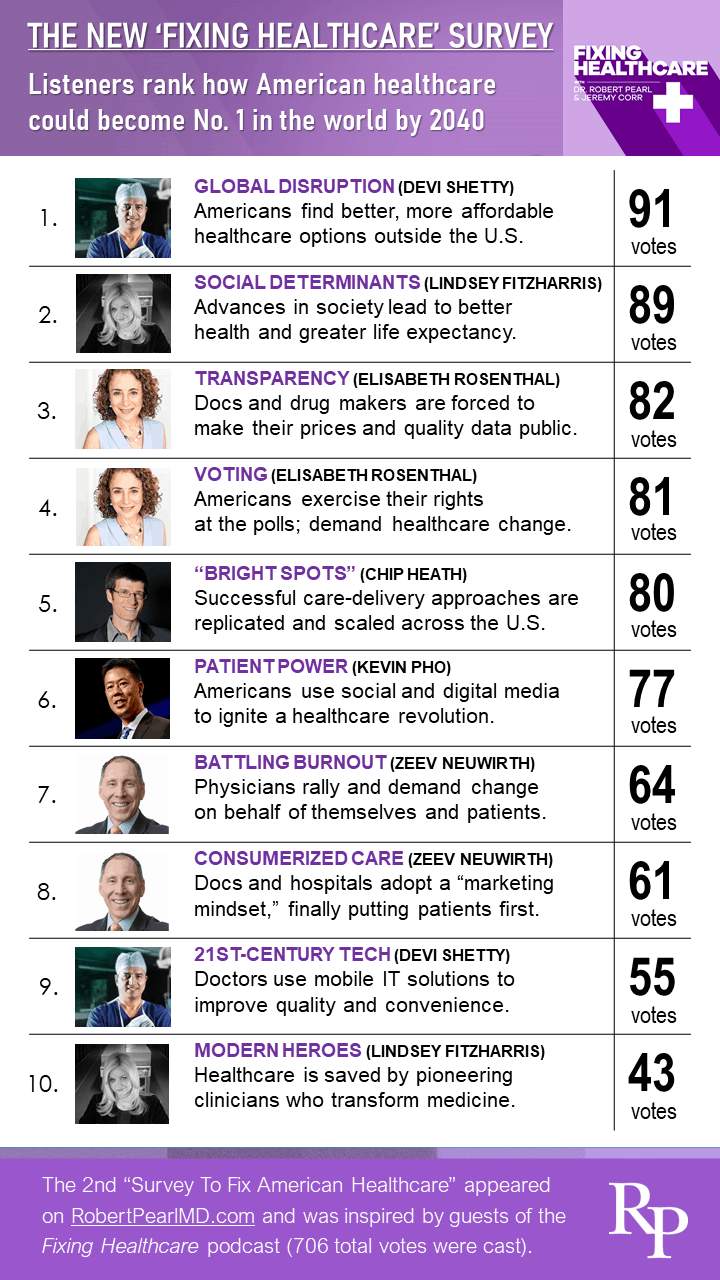
With more than 700 votes cast, here are the final tabulations (answers summarized for space):
Survey analysis
Looking at the top three results, what had once seemed impossible, now appears far more realistic and imminent.
- As Devi Shetty discussed, the world is now shrinking. Just a month ago, very few Americans knew it was possible to obtain medical care via video. Now it is a growing reality, one people will expect once the pandemic has abated. And why should that expertise be limited by national boundaries?
- My interview with medical historian Lindsey Fitzharris revolved heavily around the notion that conditions outside of hospitals have long had a more significant impact on human health than what happens inside them. As we now know, COVID-19 disproportionately harms people who smoke, have chronic diseases and live in lower-income areas. Let’s hope our nation focuses more intently on preventing these issues once the pandemic is over.
- Finally, Elisabeth Rosenthal has long used her media platform to fight for greater transparency. And yet, the business of medicine has long thrived on its opacity. The consequences are now on full display. Poor preparation, early errors in testing and ongoing cost confusion have stifled our nation’s response to the COVID-19 outbreak—proving just as destructive as the virus itself.
Hopefully our nation will learn from these failures—not just for when the next virus hits, but for years after the current crisis.
Fixing Healthcare is a part of the New Books Network (NBN) and a co-production of Dr. Robert Pearl and Jeremy Corr. Subscribe to the show via iTunes or wherever you find podcasts. Join the conversation or refer a potential candidate to us by following the show on Twitter @fixingHCpodcast, liking us on Facebook and visiting our LinkedIn page.
Dr. Pearl,
This really makes sense. WE can only hope. My experience was a terrible one with a wife who died after 2 years of mismanagement and poor care. But yes I still was expected to pay $800,000 out of pocket. Healthcare as a business is flawed because by its very nature we have to accept what we are offered…in most cases shopping is not an option. So how do we take a business without the traditional market forces to check it and make is sustainable and fair to all. Hope you keep the ball rolling and help figure it out.
I had to fax in directions to nurses neurosurgeons every morning…they had to use my directions…which were basic in nature as we attempted to stabilize a situation that had gone out of control. Crazy times). Once in a meeting with the Hospitals Directors and Key Attending Physicians..the lead neurosurgeon stated that what worked for 99% of patients…did not work for my wife.. The meeting was to discuss changes I wanted in the protocols based on data i compiled..(long story). Everyone started to get up. I stopped them and said did you hear what the Dr said? It’s obvious that what you are doing is not working yet…you won’t try something different. After that everyone sat down and I explained what I thought could work. They agreed to try it under strict guidelines of course. It worked) I learned the hard way that doctors practice medicine..but that practice gets blurred over time and although they are pretty smart..obvious problem solving can get lost easily.
My point is …not Doctors who are to fault for the breakdown in healthcare….it’s an institutional and systemic problem and people with talents in solving process based problems should be involved.
Ken