

Patients are already using generative AI tools like ChatGPT, Claude and Gemini for advice on symptoms, diagnoses, test results, medications and treatment options. Last month’s survey asked whether clinicians should play an active role in helping patients use GenAI for medical care, and if so, what would that role look like? Here are the results, followed by my analysis:
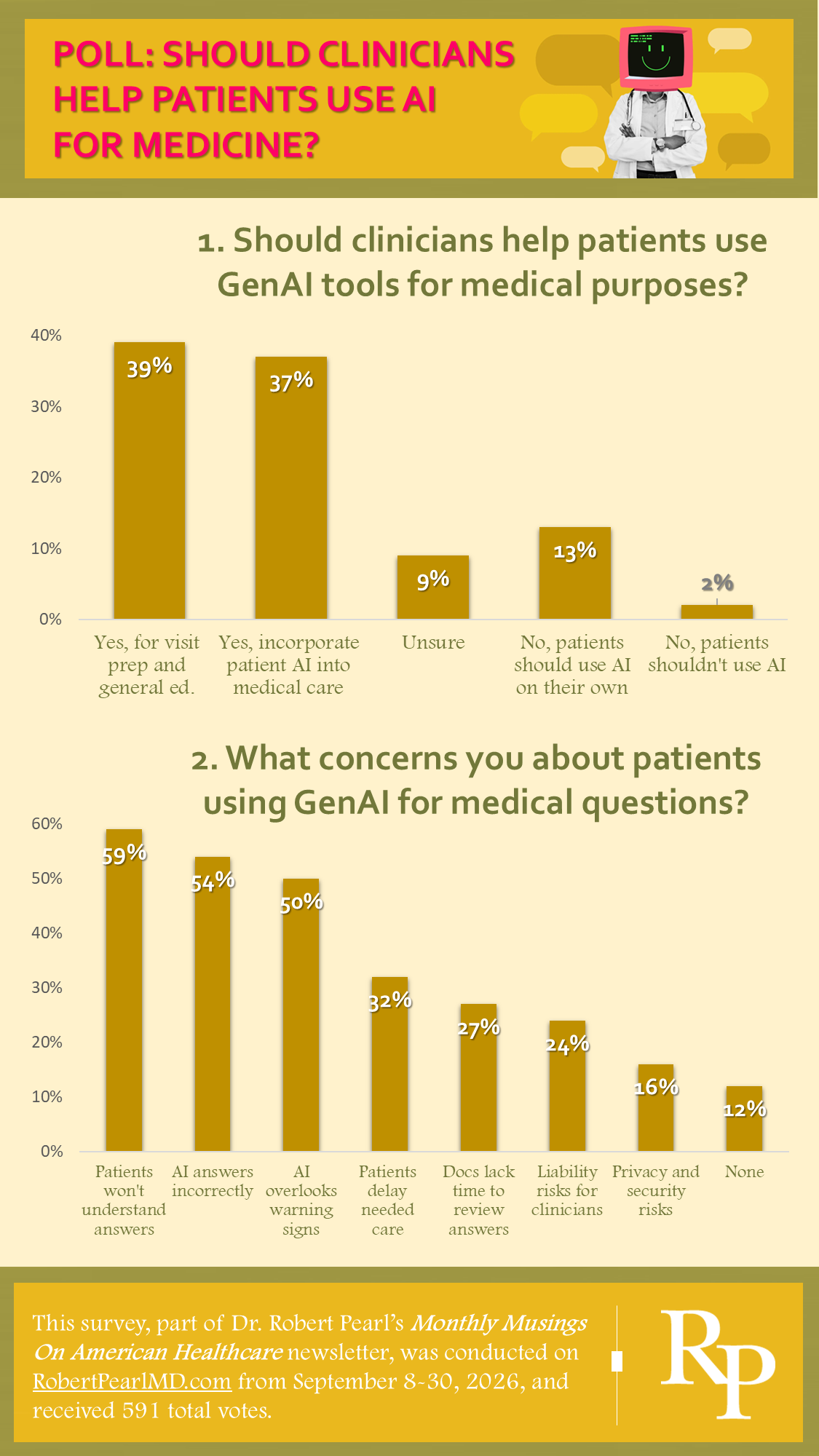
My thoughts: Monthly Musings respondents appear to be moving quickly in their acceptance of generative AI in medicine. Three-quarters said clinicians should either encourage patients to use these tools for education and visit preparation or actively incorporate patient-facing AI into medical care.
To me, that signals an important and rapid shift. The progress of these tools is happening even faster than I predicted when the first large language models were released. The important question now is whether clinicians will help guide that use or leave patients to navigate these tools on their own.
The concerns readers identified are appropriate. Patients may misunderstand AI-generated answers. The answers may be inaccurate or misleading. The tools may miss urgent warning signs. Patients may delay needed care.
But those risks are not reasons to ignore GenAI. They are instead reasons to use it more often and more intelligently. The current healthcare system already struggles with most of the same problems readers identified. Studies have found that as many as half of patients leave medical visits without fully understanding what they were told. Meanwhile, diagnostic error remains one of healthcare’s most serious safety problems, with roughly 795,000 Americans dying or becoming permanently disabled each year because of missed, delayed or wrong diagnoses.
The most promising future is not AI replacing clinicians nor patients relying on these tools alone. It is the combination of dedicated clinicians, empowered patients and GenAI tools achieving clinical outcomes exponentially better than any of the three alone.
Thanks to all who voted! To participate in future surveys, and for access to timely news and opinion on American healthcare, sign up for my free (and ad-free) newsletter Monthly Musings on American Healthcare.