

For many physicians, medicine began as a calling rooted in service, trust and professional purpose. But today’s healthcare environment is shaped by financial pressures, administrative demands, market consolidation, new technologies and changing expectations from patients, employers, insurers and policymakers.
Last month’s survey asked for your perspective on how corporatization impacts clinicians’ sense of mission and well-being. Here are the results with my thoughts below the graphic.
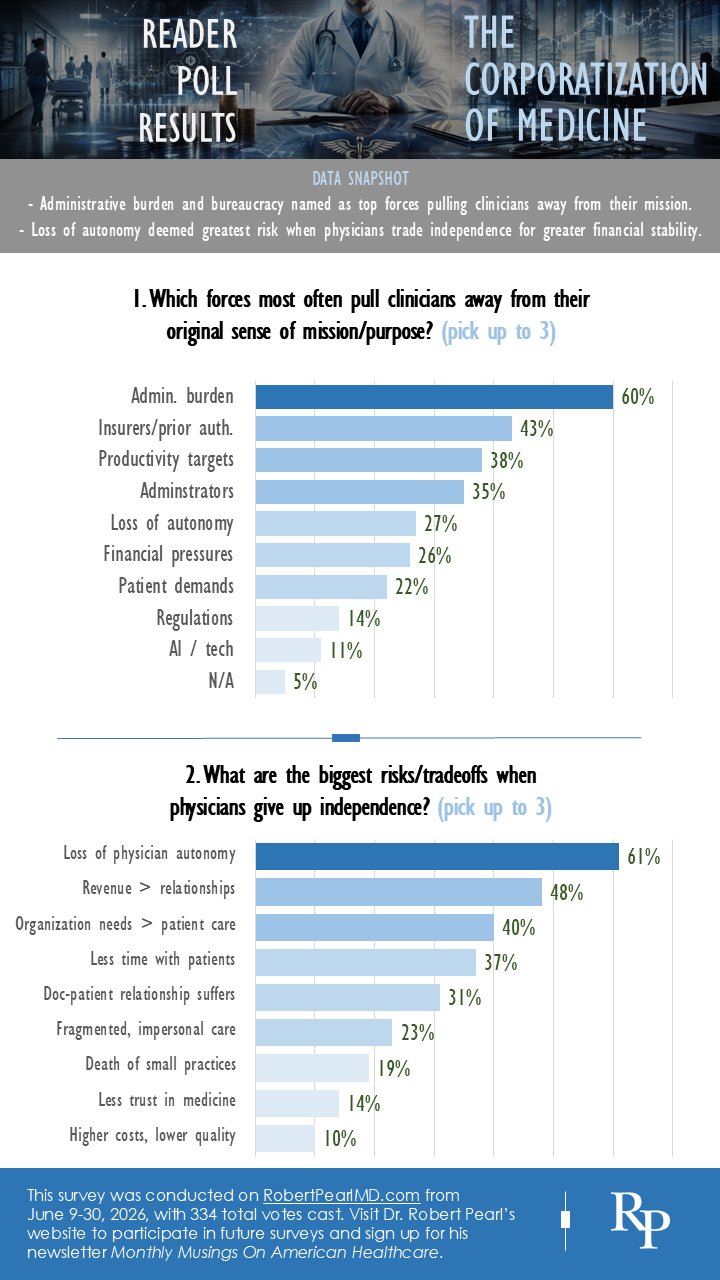
MY THOUGHTS: These results of last month’s survey point to a deeper problem than “corporatization” alone. Readers identified administrative burden, insurers, prior authorization, productivity pressure and health system administrators as the forces most likely to pull clinicians away from their original sense of mission. And they named loss of autonomy as the greatest risk when physicians trade independence for greater financial stability.
These two sets of answers are closely connected. Doctors are frustrated with the growing amount of time they spend on administrative tasks, documentation and insurance approvals rather than patient care.
Prior authorization is especially problematic. Many clinicians experience it as pointless interference. But it was introduced, in part, because healthcare costs were rising faster than businesses, families and government programs could afford. For insurers, prior authorization became the best way to flatten the cost curve. If ordering expensive tests, procedures and medications became more time-consuming, clinicians would be forced to think twice before recommending them. For doctors and patients, that friction is maddening. For insurers, it is a feature, not a bug.
But joining a hospital or health system does not eliminate professional disappointment. Physicians who sell or close their practices in search of financial stability, administrative support and negotiating power often encounter a different frustration: the loss of autonomy. Once employed, they most often face pressure to keep referrals inside the system, meet productivity targets and follow rules set far from the exam room.
That is the bind physicians face. Remain independent, and they must battle powerful insurers with limited leverage. Join a hospital, health system or private-equity-backed group, and they may gain support while losing control over how they practice. It should be no surprise that burnout and dissatisfaction remain so prevalent in American medicine. The path forward requires a different strategy. Physicians can use generative AI to improve quality, reduce waste and lower costs on behalf of patients. They can also seek contracts with self-funded employers and insurers based on clinical outcomes rather than the volume of care delivered. But if they don’t lead the way, most will remain frustrated.
Thanks to all who voted. To participate in future surveys, and for access to timely news and opinion on American healthcare, sign up for my free (and ad-free) newsletter Monthly Musings on American Healthcare.
* * *
Dr. Robert Pearl is the former CEO of The Permanente Medical Group, the nation’s largest physician group. He’s a Forbes contributor, bestselling author, Stanford University professor, and host of two healthcare podcasts. Check out Pearl’s newest book, ChatGPT, MD: How AI-Empowered Patients & Doctors Can Take Back Control of American Medicine with all profits going to Doctors Without Borders.
Robert, we need an impactful consensus that the present medical industry ecosystem cannot be fixed, and will collapse under the weight of its own hubris. Gravity always wins. A statistic that is not being collected and updated would display the likelihood that the present system is actually causing more deaths than lives saved. Ponder that….
Mission/purpose developed by many physicians during academic training is distant from the day-to-day working for a large corporate medical model. Patients’ expectations from medical care have soared, despite concurrent increase in complexity of issues and aging population. This has combined with increased administrative demands on physicians (mainly daily/constant data entry into EMR and sometimes unpaid administrative roles) with loss of professionalism/autonomy on how that care is delivered on many fronts. All of this despite working in one of the better, more integrated, and physician-run organizations.
Robert,
I have followed your writings and podcasts for several years. I am impressed a plastics man has the perspective of the value of primary care when thinking about our society. I as a recently retired primary care doc (internal med) agree with the often undervalued role and impact of the PCP. I have seen changes in my 35 years of post graduate practice. No doubt the “corporatization of medicine” has been one of the most profound. Yes, it has occurred due to the perception/reality of more control of our lifestyles including comparatively better pay. Then, through evolution/erosion of that situation further loss of autonomy has occurred.
I remain convinces the best medical care offered to a society remains a strong primary care base (perhaps biased, but the data is there to support). However, I am still not sure how to orchestrate this betterment for future generations. We can all see the negatives in our current system. Of course, it is an order of magnitude more challenging to provide a solution to the situation. The etiology of the problems: money, capitalism, money, third party special interests, money, litigation fears, money, patient demands, money…….You get the point.
I have read your ideas about having Center of Excellences which perform specific specialty care. Yes, I could understand how it may work. And, no, I do not believe it will work. The general population will not agree to fly to parts of the states where family cannot easily access. Plus, the local specialists will fight it tooth and nail. This specialty generated stance by the local specialists is what has degraded the efficiency of even local value based care. These are doctors hurting other doctors for fear of losing economic power. Just one of the obstacles to making change.
I am about to read Jordan Grumet book, The Healthcare Heist, I’ve heard him speak on it. My concern is it will be heavy on “bitch’in” and light on “fix’in.” I think we can all do the complaining part well.
Part of me also wonders if most of the non-geriatric age individuals actually want to interact with a PCP? I will share with you a brief, but impactful moment in my life. Over a decade ago I was watching CSPAN on a Sunday morning. Peter Thiel was being interviewed about health care. The interviewer asked Peter, “What about your primary care doctor?” Peter fumbled with one of his pants pockets and pulls out his iPhone. I’ll paraphrase, “Oh, here is my PCP.” That was a gut punch for me! As AI continues to advance we are even closer to that being a reality. Will that be a better way to administer healthcare in America?
Sincerely,
Another Robert