

Healthcare decisions by policymakers, insurers and providers almost always involve tradeoffs. Improving one aspect of care might mean higher costs, longer wait times or reduced access somewhere else.
Last month’s survey asked a more personal question: What factors are most important when you or your family need medical care? And what aspects of care are you willing to give up? Here are the results:
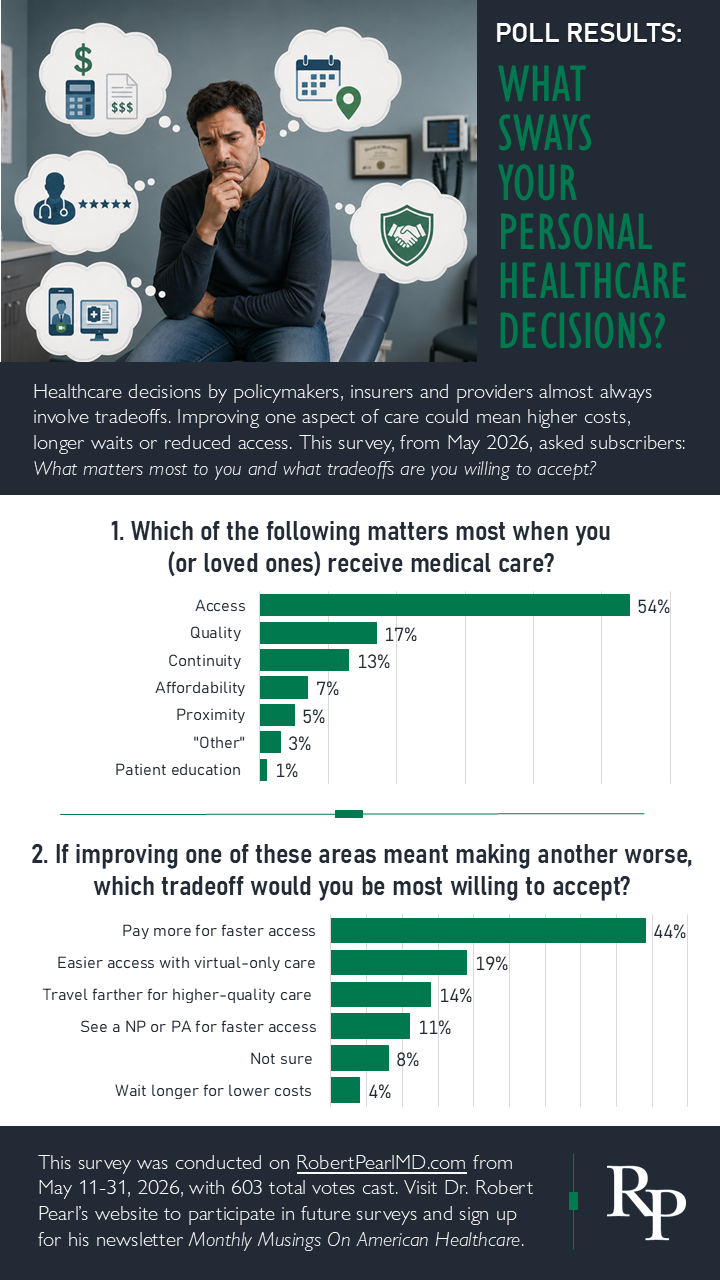
My thoughts: I love when readers surprise me with their answers, and last month’s Musings survey certainly did. Based on national polls, I expected cost to rank near the top. And as a physician, I hoped quality would be high on the list. Instead, access came first. That result highlights the magnitude of a growing healthcare crisis.
Most Monthly Musings subscribers likely have medical insurance through an employer, Medicare or a healthcare exchange. For people with good coverage, rising costs remain a concern, but the magnitude of financial exposure is lower than for uninsured or underinsured Americans. And for those insured individuals who are healthy, out-of-pocket expenses remain manageable, if still frustrating, much like rising grocery or gas prices.
What is changing is that even people with coverage are finding it harder to get care when they need it. When they try to schedule a primary care or specialty visit, many face waits far longer than they want or remember from the past. Access challenges have been a reality for years for the uninsured and for many people on Medicaid. But now, delayed access is becoming a fact of life for the middle class and even the relatively affluent. What we are seeing in healthcare today is the intersection of rising demand for medical care and a growing shortage of physicians.
The solution will not simply be more doctors. It takes close to 10 years to complete medical school and residency. Nurse practitioners, physician assistants and other clinicians can help expand access. But increasingly, patients are also turning to generative AI to obtain immediate information, expertise and advice. Whether physicians welcome this trend or fear it, the access challenges highlighted by this survey suggest that reliance on technology-enabled medical guidance will continue to grow rapidly.
Finally, the willingness of nearly half of respondents to pay more for faster access points to another concerning trend: the emergence of a “K-shaped” healthcare economy. Just as retail, travel and other industries have created premium tiers for those willing and able to pay more, American medicine may increasingly divide into faster, more convenient access for some and longer waits for everyone else. In that sense, concierge medicine could soon become the healthcare equivalent of business-class travel.
Thanks to all who voted! To participate in future surveys, and for access to timely news and opinion on American healthcare, sign up for my free (and ad-free) newsletter Monthly Musings on American Healthcare.