
Generative AI tools like ChatGPT and DeepSeek are now easily accessible to both clinicians and patients. In a previous newsletter, I invited readers to try these tools for themselves. In this poll, I wanted to learn how you view generative AI as a medical tool. Here are the results:
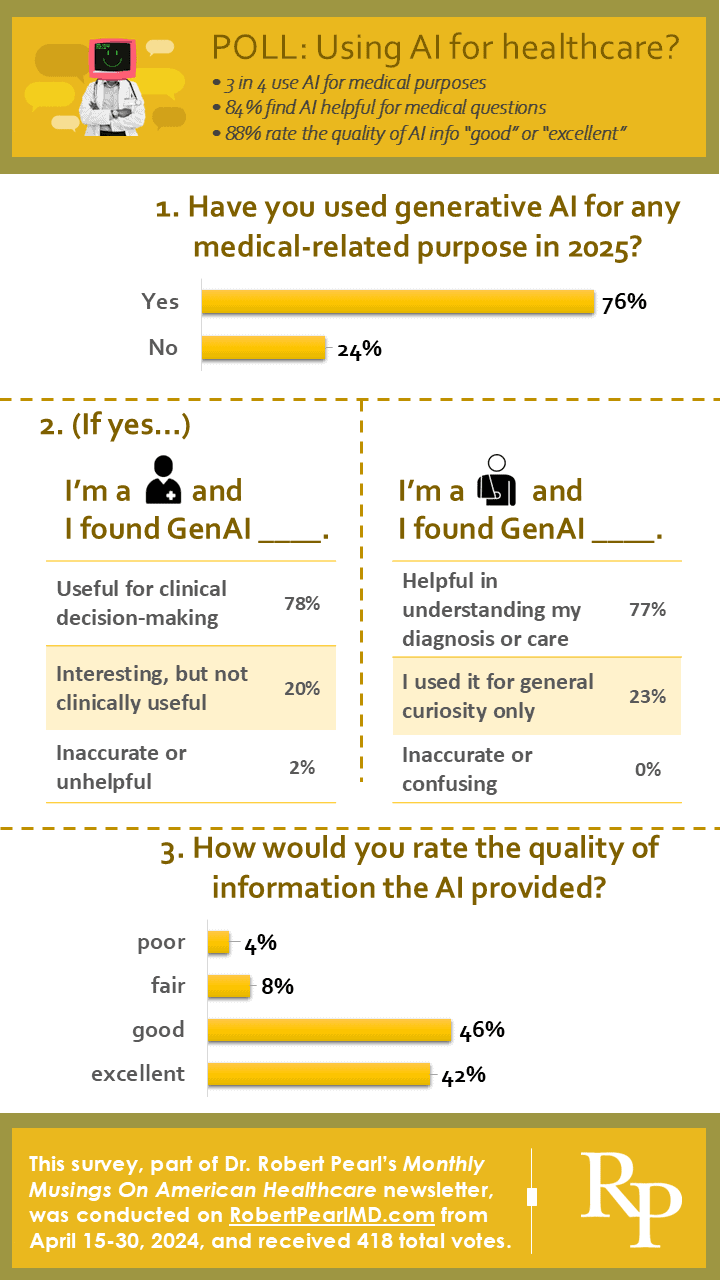
My thoughts: People’s attitudes toward generative AI are shifting at a speed that surprises even me. Just one year ago, I predicted it would take several years for patients and clinicians to experiment with these tools in meaningful ways. But the survey results tell a different story: three-quarters of respondents—both patients and clinicians—have already used a generative AI tool like ChatGPT or DeepSeek for a medical-related purpose.
Moreover, they report a very positive experience. To put the results in perspective, imagine asking these same groups about electronic health records (EHRs). It’s hard to imagine that 88% would describe their experience as “excellent” or “good.”
The contrast speaks volumes. Based on this survey, generative AI (and the large language models that power it) are crossing into mainstream healthcare far more smoothly and quickly than people predicted. The big question is whether this surge in use is limited to the highly informed, tech-savvy audience of Monthly Musings or whether it signals a broader shift in healthcare across the country. Either way, the momentum is unmistakable, and the ripple effects will continue to shape medicine in the months and years ahead.
Thanks to all who voted! To participate in future surveys, and for access to timely news and opinion on American healthcare, sign up for my free (and ad-free) newsletter Monthly Musings on American Healthcare.
Dr. Robert Pearl’s article on generative AI in healthcare offers a compelling vision for transforming patient care. He highlights AI’s potential to enhance diagnostic accuracy, reduce medical errors, and empower patients with personalized insights. While optimistic, he also addresses challenges such as data privacy, algorithmic bias, and the need for clinician oversight. Pearl’s balanced perspective underscores AI’s promise in augmenting, rather than replacing, human expertise in medicine. His insights are timely and thought-provoking for healthcare professionals and patients alike.
I have come to the realization that the human body is highly complex and varies a lot from person to person, making it hard for any clinician to diagnose accurately all the time. The many books written on this subject including some of your books have led me to this notion.
AI enabled diagnostic tools available to the patients, will help speed up the diagnosis. I believe I know my body well and I can parse through the information given by the AI tools and can then consult with the clinician to firm up the diagnosis.
With the looming shortage of physicians and the wait time involved in getting appointments, “Diagnose Globally and Treat Locally” may be the future of medical care in America, sort of an inverse of the call center model used in other customer service industries.